GitLab CI/CD Integration with QA Sphere
Automatically upload test results from your GitLab CI/CD pipelines to QA Sphere using the QAS CLI tool. This integration eliminates manual result entry and provides instant visibility into your automated test results.
What You'll Achieve
With this integration, every time your GitLab pipeline runs:
- Test results automatically upload to QA Sphere
- New test runs are created with pipeline information
- Tests are matched to existing QA Sphere test cases
- Pass/fail status, execution time, and screenshots are recorded
- Test history and trends are tracked over time
Prerequisites
Before starting, ensure you have:
- A GitLab project with automated tests (Playwright, Cypress, Jest, etc.)
- Tests configured to generate JUnit XML format results
- A QA Sphere account with Test Runner role or higher
- Test cases in QA Sphere with markers (e.g.,
BD-001,PRJ-123)
How It Works
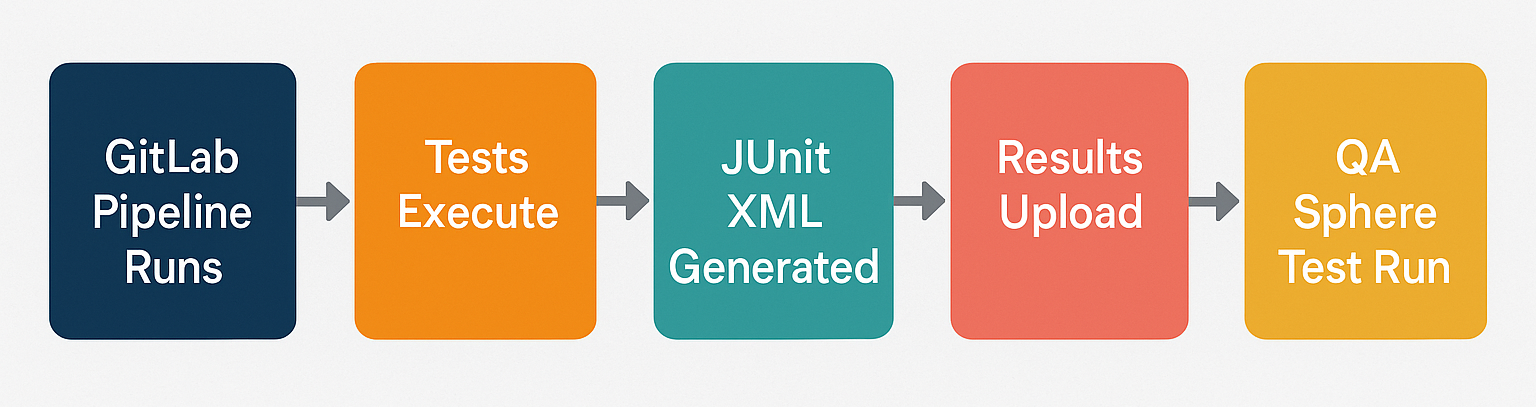
- Your pipeline runs automated tests
- Tests generate JUnit XML results file
- QAS CLI tool reads the XML file
- CLI matches tests to QA Sphere cases using markers
- Results are uploaded and appear in QA Sphere
Setup Steps
Step 1: Create QA Sphere API Key
- Log into your QA Sphere account
- Click the gear icon ⚙️ in the top right → Settings
- Navigate to API Keys
- Click Create API Key
- Copy and save the key - you won't see it again!
Your API key format: t123.ak456.abc789xyz
Step 2: Configure GitLab Variables
Add these secrets to your GitLab project:
- Go to your GitLab project
- Navigate to Settings → CI/CD → Variables
- Click Add variable and create:
| Key | Value | Flags |
|---|---|---|
QAS_TOKEN | Your API key (e.g., t123.ak456.abc789xyz) | Protected, Masked |
QAS_URL | Your QA Sphere URL (e.g., https://company.eu1.qasphere.com) | Protected |
- Click Add variable to save
Never commit API keys to your repository. Always use GitLab CI/CD variables.
Step 3: Add Test Case Markers
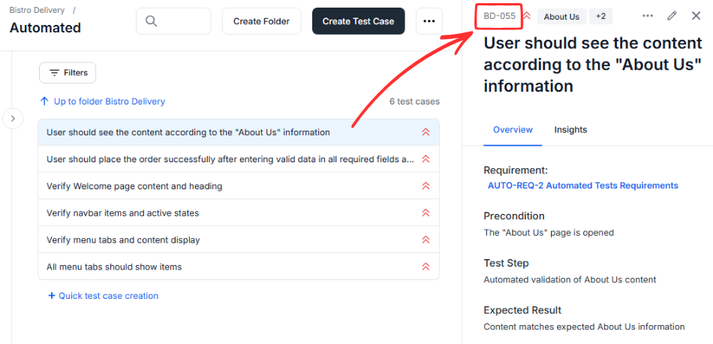
Ensure your test names include QA Sphere markers in the format PROJECT-SEQUENCE.
These markers can be found in QA Sphere interface for each test case separately.
Playwright Example:
test('BD-001: User can login with valid credentials', async ({ page }) => {
  await page.goto('https://example.com/login');
  await page.fill('#username', '[email protected]');
  await page.fill('#password', 'password123');
  await page.click('#login-button');
  await expect(page).toHaveURL('/dashboard');
});

test('BD-002: User sees error with invalid credentials', async ({ page }) => {
  // test implementation
});
Cypress Example:
describe('Login Flow', () => {
  it('BD-001: should login successfully with valid credentials', () => {
    cy.visit('/login');
    cy.get('#username').type('[email protected]');
    cy.get('#password').type('password123');
    cy.get('#login-button').click();
    cy.url().should('include', '/dashboard');
  });
});
Jest Example:
describe('API Tests', () => {
  test('BD-015: GET /users returns user list', async () => {
    const response = await fetch('/api/users');
    expect(response.status).toBe(200);
    const data = await response.json();
    expect(data).toHaveLength(5);
  });
});
Step 4: Configure Test Framework
Configure your test framework to generate JUnit XML output:
Playwright Configuration
// playwright.config.js
const { defineConfig } = require('@playwright/test');

module.exports = defineConfig({
  testDir: './tests',
  timeout: 30000,

  // JUnit reporter for CI/CD
  reporter: [
    ['list'],  // Console output
    ['junit', { outputFile: 'junit-results/results.xml' }]  // For QA Sphere
  ],

  use: {
    headless: true,
    screenshot: 'only-on-failure',
    video: 'retain-on-failure',
  },

  projects: [
    { name: 'chromium', use: { browserName: 'chromium' } },
    { name: 'firefox', use: { browserName: 'firefox' } },
    { name: 'webkit', use: { browserName: 'webkit' } },
  ],
});
Cypress Configuration
// cypress.config.js
const { defineConfig } = require('cypress');

module.exports = defineConfig({
  e2e: {
    reporter: 'cypress-multi-reporters',
    reporterOptions: {
      configFile: 'reporter-config.json'
    }
  }
});
// reporter-config.json
{
  "reporterEnabled": "spec, mocha-junit-reporter",
  "mochaJunitReporterReporterOptions": {
    "mochaFile": "junit-results/results.xml"
  }
}
Jest Configuration
// jest.config.js
module.exports = {
  reporters: [
    'default',
    ['jest-junit', {
      outputDirectory: './junit-results',
      outputName: 'results.xml',
      classNameTemplate: '{classname}',
      titleTemplate: '{title}'
    }]
  ]
};
Step 5: Create GitLab Pipeline
Create or update .gitlab-ci.yml in your repository root:
For Playwright Projects
stages:
  - test
  - report

variables:
  # Disable Husky git hooks in CI
  HUSKY: 0

# Run Playwright tests
test:
  stage: test
  # IMPORTANT: Match image version to your @playwright/test package version
  image: mcr.microsoft.com/playwright:v1.51.1-jammy
  script:
    - npm ci
    - npx playwright test

  artifacts:
    when: always  # Upload artifacts even if tests fail
    paths:
      - junit-results/
      - test-results/
      - playwright-report/
    reports:
      junit: junit-results/results.xml
    expire_in: 1 week

  rules:
    - if: $CI_COMMIT_BRANCH == "main"
    - if: $CI_COMMIT_BRANCH == "develop"
    - if: $CI_PIPELINE_SOURCE == "merge_request_event"

# Upload results to QA Sphere
upload-to-qasphere:
  stage: report
  image: node:18
  needs:
    - job: test
      artifacts: true
  before_script:
    - npm install -g qas-cli
  script:
    # Upload test results (automatically creates new run)
    - qasphere junit-upload ./junit-results/results.xml

    - echo "✅ Test results uploaded to QA Sphere"

  when: always
  allow_failure: true

  rules:
    - if: $CI_COMMIT_BRANCH == "main"
    - if: $CI_COMMIT_BRANCH == "develop"
    - if: $CI_PIPELINE_SOURCE == "merge_request_event"
For Cypress Projects
stages:
  - test
  - report

test:
  stage: test
  image: cypress/browsers:node18.12.0-chrome107
  script:
    - npm ci
    - npx cypress run

  artifacts:
    when: always
    paths:
      - junit-results/
      - cypress/videos/
      - cypress/screenshots/
    reports:
      junit: junit-results/results.xml
    expire_in: 1 week

  rules:
    - if: $CI_COMMIT_BRANCH == "main"
    - if: $CI_COMMIT_BRANCH == "develop"
    - if: $CI_PIPELINE_SOURCE == "merge_request_event"

upload-to-qasphere:
  stage: report
  image: node:18
  needs:
    - job: test
      artifacts: true
  before_script:
    - npm install -g qas-cli
  script:
    - qasphere junit-upload ./junit-results/results.xml
    - echo "✅ Results uploaded to QA Sphere"
  when: always
  allow_failure: true
  rules:
    - if: $CI_COMMIT_BRANCH == "main"
    - if: $CI_COMMIT_BRANCH == "develop"
    - if: $CI_PIPELINE_SOURCE == "merge_request_event"
For Jest Projects
stages:
  - test
  - report

test:
  stage: test
  image: node:18
  script:
    - npm ci
    - npm test

  artifacts:
    when: always
    paths:
      - junit-results/
      - coverage/
    reports:
      junit: junit-results/results.xml
    expire_in: 1 week

  rules:
    - if: $CI_COMMIT_BRANCH == "main"
    - if: $CI_COMMIT_BRANCH == "develop"
    - if: $CI_PIPELINE_SOURCE == "merge_request_event"

upload-to-qasphere:
  stage: report
  image: node:18
  needs:
    - job: test
      artifacts: true
  before_script:
    - npm install -g qas-cli
  script:
    - qasphere junit-upload ./junit-results/results.xml
    - echo "✅ Results uploaded to QA Sphere"
  when: always
  allow_failure: true
  rules:
    - if: $CI_COMMIT_BRANCH == "main"
    - if: $CI_COMMIT_BRANCH == "develop"
    - if: $CI_PIPELINE_SOURCE == "merge_request_event"
Step 6: Push and Verify
- Commit your changes:
git add .gitlab-ci.yml playwright.config.js  # or your config files
git commit -m "Add GitLab CI/CD with QA Sphere integration"
git push origin main
-
Monitor the pipeline:
- Go to GitLab → Build → Pipelines
- Watch your pipeline execute
- Check both
testandupload-to-qaspherestages

-
Verify in QA Sphere:
- Log into QA Sphere
- Navigate to your project → Test Runs
- See the new run with your test results
Advanced Usage
Available CLI Options
The QAS CLI junit-upload command creates a new test run within a QA Sphere project from your JUnit XML files or uploads results to an existing run.
qasphere junit-upload [options] <path-to-junit-xml>
Options:
-r, --run-url <url>- Upload to an existing test run (otherwise creates a new run)--run-name <template>- Name template for creating new test runs (only used when--run-urlis not specified)--attachments- Detect and upload attachments (screenshots, videos, logs)--force- Ignore API request errors, invalid test cases, or attachment issues-h, --help- Show command help
Run Name Template Placeholders
The --run-name option supports the following placeholders:
Environment Variables:
{env:VARIABLE_NAME}- Any environment variable (e.g.,{env:CI_PIPELINE_ID},{env:CI_COMMIT_SHA})
Date Placeholders:
{YYYY}- 4-digit year (e.g., 2025){YY}- 2-digit year (e.g., 25){MMM}- 3-letter month (e.g., Jan, Feb, Mar){MM}- 2-digit month (e.g., 01, 02, 12){DD}- 2-digit day (e.g., 01, 15, 31)
Time Placeholders:
{HH}- 2-digit hour in 24-hour format (e.g., 00, 13, 23){hh}- 2-digit hour in 12-hour format (e.g., 01, 12){mm}- 2-digit minute (e.g., 00, 30, 59){ss}- 2-digit second (e.g., 00, 30, 59){AMPM}- AM/PM indicator
Default Template:
If --run-name is not specified, the default template is:
Automated test run - {MMM} {DD}, {YYYY}, {hh}:{mm}:{ss} {AMPM}
Example Output:
Automated test run - Jan 15, 2025, 02:30:45 PM
The --run-name option is only used when creating new test runs (i.e., when --run-url is not specified).
Usage Examples:
# Create new run with default name template
qasphere junit-upload ./junit-results/results.xml

# Upload to existing run (--run-name is ignored)
qasphere junit-upload -r https://company.eu1.qasphere.com/project/BD/run/42 ./junit-results/results.xml

# Simple static name
qasphere junit-upload --run-name "v1.4.4-rc5" ./junit-results/results.xml

# With environment variables
qasphere junit-upload --run-name "Pipeline #{env:CI_PIPELINE_ID} - {env:CI_COMMIT_REF_NAME}" ./junit-results/results.xml
# Output: "Pipeline #12345 - main"

# With date placeholders
qasphere junit-upload --run-name "Release {YYYY}-{MM}-{DD}" ./junit-results/results.xml
# Output: "Release 2025-01-15"

# With date and time placeholders
qasphere junit-upload --run-name "Nightly Tests {MMM} {DD}, {YYYY} at {HH}:{mm}" ./junit-results/results.xml
# Output: "Nightly Tests Jan 15, 2025 at 22:34"

# Complex template with multiple placeholders
qasphere junit-upload --run-name "Build {env:BUILD_NUMBER} - {YYYY}/{MM}/{DD} {hh}:{mm} {AMPM}" ./junit-results/results.xml
# Output: "Build v1.4.4-rc5 - 2025/01/15 10:34 PM"

# With attachments
qasphere junit-upload --attachments ./junit-results/results.xml

# Multiple files
qasphere junit-upload ./junit-results/*.xml

# Force upload on errors
qasphere junit-upload --force ./junit-results/results.xml
Upload to Existing Test Run
To update a specific test run instead of creating a new one:
upload-to-qasphere:
  script:
    - |
      RUN_ID=42  # Your run ID
      qasphere junit-upload \
        -r ${QAS_URL}/project/BD/run/${RUN_ID} \
        ./junit-results/results.xml
Upload with Attachments
Include screenshots and logs with your results:
upload-to-qasphere:
  script:
    - qasphere junit-upload --attachments ./junit-results/results.xml
The CLI automatically detects and uploads:
- Screenshots from test failures
- Video recordings
- Log files
- Any files referenced in the JUnit XML
Upload Multiple XML Files
If you have multiple test suites generating separate XML files:
upload-to-qasphere:
  script:
    - qasphere junit-upload ./junit-results/*.xml
Branch-Specific Runs
Create different runs for different branches:
upload-to-qasphere:
  script:
    - |
      if [ "$CI_COMMIT_REF_NAME" = "main" ]; then
        # Upload to production run
        qasphere junit-upload -r ${QAS_URL}/project/BD/run/100 ./junit-results/results.xml
      elif [ "$CI_COMMIT_REF_NAME" = "develop" ]; then
        # Upload to development run
        qasphere junit-upload -r ${QAS_URL}/project/BD/run/101 ./junit-results/results.xml
      else
        # Create new run for feature branches
        qasphere junit-upload ./junit-results/results.xml
      fi
Add Pipeline Metadata
Use the --run-name option to include GitLab pipeline information in test run titles:
upload-to-qasphere:
  script:
    # Include pipeline ID and branch name
    - |
      qasphere junit-upload \
        --run-name "Pipeline #{env:CI_PIPELINE_ID} - {env:CI_COMMIT_REF_NAME}" \
        ./junit-results/results.xml
    # Output: "Pipeline #12345 - main"
Common GitLab Variables:
{env:CI_PIPELINE_ID}- Pipeline ID number{env:CI_COMMIT_REF_NAME}- Branch or tag name{env:CI_COMMIT_SHORT_SHA}- Short commit SHA{env:CI_COMMIT_SHA}- Full commit SHA{env:GITLAB_USER_NAME}- User who triggered the pipeline{env:CI_JOB_NAME}- Current job name
Examples:
# Pipeline with date and time
- qasphere junit-upload --run-name "Pipeline #{env:CI_PIPELINE_ID} - {YYYY}-{MM}-{DD} {HH}:{mm}" ./junit-results/results.xml

# Branch and commit info
- qasphere junit-upload --run-name "{env:CI_COMMIT_REF_NAME} - {env:CI_COMMIT_SHORT_SHA}" ./junit-results/results.xml

# Complete metadata
- qasphere junit-upload --run-name "Build #{env:CI_PIPELINE_ID} ({env:CI_COMMIT_REF_NAME}) - {MMM} {DD}, {hh}:{mm} {AMPM}" ./junit-results/results.xml
Force Upload on Errors
Continue uploading even if some tests can't be matched:
upload-to-qasphere:
  script:
    - qasphere junit-upload --force ./junit-results/results.xml
Common Scenarios
Scenario 1: Nightly Test Runs
Run tests on a schedule and upload results with descriptive names:
test:
  rules:
    - if: $CI_PIPELINE_SOURCE == "schedule"  # Only run on scheduled pipelines
    - if: $CI_COMMIT_BRANCH == "main"

upload-to-qasphere:
  script:
    # Create run with date in the name
    - qasphere junit-upload --run-name "Nightly Tests - {YYYY}-{MM}-{DD}" ./junit-results/results.xml
    # Output: "Nightly Tests - 2025-01-15"

    # Or with time included
    - qasphere junit-upload --run-name "Nightly {MMM} {DD}, {YYYY} at {HH}:{mm}" ./junit-results/results.xml
    # Output: "Nightly Jan 15, 2025 at 22:30"
Create the schedule in GitLab: CI/CD → Schedules → New schedule
Scenario 2: Parallel Test Execution
Run tests in parallel and upload all results:
test-unit:
  stage: test
  script:
    - npm run test:unit
  artifacts:
    paths:
      - junit-results/unit-results.xml

test-integration:
  stage: test
  script:
    - npm run test:integration
  artifacts:
    paths:
      - junit-results/integration-results.xml

upload-to-qasphere:
  stage: report
  needs:
    - job: test-unit
      artifacts: true
    - job: test-integration
      artifacts: true
  script:
    - npm install -g qas-cli
    - qasphere junit-upload ./junit-results/*.xml
Scenario 3: Multi-Environment Testing
Test against different environments:
test-staging:
  variables:
    TEST_ENV: "staging"
    BASE_URL: "https://staging.example.com"
  script:
    - npm test
  artifacts:
    paths:
      - junit-results/staging-results.xml

test-production:
  variables:
    TEST_ENV: "production"
    BASE_URL: "https://example.com"
  script:
    - npm test
  artifacts:
    paths:
      - junit-results/production-results.xml

upload-to-qasphere:
  script:
    - npm install -g qas-cli
    - qasphere junit-upload ./junit-results/*.xml
Scenario 4: Version/Release Tagging
Tag test runs with version numbers or release names:
variables:
  VERSION: "v1.4.5"

upload-to-qasphere:
  script:
    # Simple version tag
    - qasphere junit-upload --run-name "Release {env:VERSION}" ./junit-results/results.xml
    # Output: "Release v1.4.5"

    # Version with date
    - qasphere junit-upload --run-name "Release {env:VERSION} - {YYYY}-{MM}-{DD}" ./junit-results/results.xml
    # Output: "Release v1.4.5 - 2025-01-15"

    # Pre-release/RC builds
    - qasphere junit-upload --run-name "{env:VERSION}-rc{env:CI_PIPELINE_ID}" ./junit-results/results.xml
    # Output: "v1.4.5-rc12345"
For tagged releases in GitLab:
upload-to-qasphere:
  script:
    - |
      if [ -n "$CI_COMMIT_TAG" ]; then
        # For git tags, use tag name
        qasphere junit-upload --run-name "Release {env:CI_COMMIT_TAG}" ./junit-results/results.xml
      else
        # For regular commits, use branch and commit
        qasphere junit-upload --run-name "{env:CI_COMMIT_REF_NAME} - {env:CI_COMMIT_SHORT_SHA}" ./junit-results/results.xml
      fi
  rules:
    - if: $CI_COMMIT_TAG
    - if: $CI_COMMIT_BRANCH == "main"
Troubleshooting
Issue: Tests Not Appearing in QA Sphere
Symptoms:
- Upload succeeds but no results in QA Sphere
- "Test case not found" warnings in logs
Solutions:
-
Ensure test cases exist in QA Sphere:
- Check that
BD-001,BD-002, etc. exist in your QA Sphere project - Verify the project code matches (BD, PRJ, etc.)
- Check that
-
Check marker format:
- Must be
PROJECT-NUMBERformat - Examples:
BD-001,PRJ-123,TEST-456
- Must be
Issue: Authentication Failed (401 Error)
Symptoms:
Error: Authentication failed (401)
Solutions:
-
Verify API key is correct:
- Go to QA Sphere → Settings → API Keys
- Check the key hasn't been deleted
- Regenerate if needed
-
Check GitLab variables:
- Settings → CI/CD → Variables
- Verify
QAS_TOKENis set correctly - Ensure no extra spaces or line breaks
-
Verify key permissions:
- API key must have Test Runner role or higher
- Check user permissions in QA Sphere
Issue: JUnit XML File Not Found
Symptoms:
Error: File ./junit-results/results.xml does not exist
Solutions:
- Check test job artifacts:
test:
  artifacts:
    paths:
      - junit-results/  # Make sure this matches your output path
-
Verify test framework configuration:
- Playwright: Check
playwright.config.jsreporter - Cypress: Check
reporter-config.json - Jest: Check
jest.config.jsreporters
- Playwright: Check
-
Add debug output:
upload-to-qasphere:
  script:
    - ls -la junit-results/  # List files
    - cat junit-results/results.xml  # Show content
    - qasphere junit-upload ./junit-results/results.xml
Issue: Playwright Version Mismatch
Symptoms:
Error: Executable doesn't exist at /ms-playwright/chromium...
║ - current: mcr.microsoft.com/playwright:v1.40.0-jammy
║ - required: mcr.microsoft.com/playwright:v1.51.1-jammy
Solution:
Match Docker image version to your Playwright package version:
# Check your Playwright version
npm list @playwright/test
# Output: @playwright/[email protected]
# Update .gitlab-ci.yml
test:
  image: mcr.microsoft.com/playwright:v1.51.1-jammy  # Match the version
Issue: Pipeline Fails But Tests Pass
Symptoms:
- Tests execute successfully
- Artifacts are uploaded
- Job still marked as failed
Solution:
Force job success while preserving test results:
test:
  script:
    - npm ci
    - |
      set +e
      npx playwright test
      TEST_EXIT=$?
      set -e
      echo "Tests completed with exit code: $TEST_EXIT"
      exit 0  # Force success

  artifacts:
    when: always
    paths:
      - junit-results/
Issue: Upload Job Doesn't Run
Symptoms:
- Test job completes
- Upload job never starts
Solutions:
- Check needs configuration:
upload-to-qasphere:
  needs:
    - job: test  # Must match test job name exactly
      artifacts: true
- Verify branch rules:
upload-to-qasphere:
  rules:
    - if: $CI_COMMIT_BRANCH == "main"
    - if: $CI_COMMIT_BRANCH == "develop"
    - if: $CI_PIPELINE_SOURCE == "merge_request_event"
- Check
whenclause:
upload-to-qasphere:
  when: always  # Run even if test job fails
Best Practices
1. Always Use Markers
Include QA Sphere markers in all automated tests:
// ✅ Good
test('BD-001: User can login successfully', async ({ page }) => {});

// ❌ Bad - no marker
test('User can login successfully', async ({ page }) => {});
2. Upload on Every Pipeline Run
Configure upload to run even when tests fail:
upload-to-qasphere:
  when: always
  allow_failure: true
This ensures you track both passing and failing test results.
3. Use Descriptive Run Names
Use the --run-name option to create meaningful test run titles:
upload-to-qasphere:
  script:
    # Include pipeline and branch information
    - |
      qasphere junit-upload \
        --run-name "Pipeline #{env:CI_PIPELINE_ID} - {env:CI_COMMIT_REF_NAME}" \
        ./junit-results/results.xml
For branch-specific runs, you can also upload to existing runs:
script:
  - |
    if [ "$CI_COMMIT_REF_NAME" = "main" ]; then
      # Upload to production run
      qasphere junit-upload -r ${QAS_URL}/project/BD/run/100 ./junit-results/results.xml
    elif [ "$CI_COMMIT_REF_NAME" = "develop" ]; then
      # Upload to development run
      qasphere junit-upload -r ${QAS_URL}/project/BD/run/101 ./junit-results/results.xml
    else
      # Create new run for feature branches
      qasphere junit-upload --run-name "{env:CI_COMMIT_REF_NAME} - {env:CI_COMMIT_SHORT_SHA}" ./junit-results/results.xml
    fi
4. Secure Your API Keys
- Store in GitLab CI/CD variables
- Mark as Protected and Masked
- Rotate keys periodically
- Never commit to repository
- Never log or print in pipeline
5. Upload Attachments for Failures
Help debug failures by including screenshots:
script:
  - qasphere junit-upload --attachments ./junit-results/results.xml
6. Match Playwright Versions
Always keep Docker image version in sync with npm package:
// package.json
{
  "devDependencies": {
    "@playwright/test": "1.51.1"
  }
}
# .gitlab-ci.yml
image: mcr.microsoft.com/playwright:v1.51.1-jammy
7. Test Locally First
Before pushing to GitLab, test the integration locally:
# Set environment variables
export QAS_TOKEN=your.api.key
export QAS_URL=https://company.eu1.qasphere.com

# Run tests
npm test

# Upload results
npx qas-cli junit-upload ./junit-results/results.xml
8. Monitor Upload Success
Add logging to track upload status:
upload-to-qasphere:
  script:
    - npm install -g qas-cli
    - |
      if qasphere junit-upload ./junit-results/results.xml; then
        echo "✅ Successfully uploaded results to QA Sphere"
      else
        echo "❌ Failed to upload results to QA Sphere"
        exit 1
      fi
Complete Working Example
Here's a complete, production-ready configuration:
# .gitlab-ci.yml
stages:
  - test
  - report

variables:
  HUSKY: 0
  PLAYWRIGHT_VERSION: "1.51.1"

# Cache node modules for faster builds
cache:
  paths:
    - node_modules/

# Run Playwright tests
test:
  stage: test
  image: mcr.microsoft.com/playwright:v${PLAYWRIGHT_VERSION}-jammy
  before_script:
    - npm ci
  script:
    - npx playwright test
  artifacts:
    when: always
    paths:
      - junit-results/
      - test-results/
      - playwright-report/
    reports:
      junit: junit-results/results.xml
    expire_in: 1 week
  retry:
    max: 1
    when:
      - runner_system_failure
  rules:
    - if: $CI_COMMIT_BRANCH == "main"
    - if: $CI_COMMIT_BRANCH == "develop"
    - if: $CI_PIPELINE_SOURCE == "merge_request_event"
  tags:
    - docker

# Upload results to QA Sphere
upload-to-qasphere:
  stage: report
  image: node:18
  needs:
    - job: test
      artifacts: true
  before_script:
    - npm install -g qas-cli
  script:
    # Verify file exists
    - test -f junit-results/results.xml || (echo "Results file not found" && exit 1)

    # Upload with descriptive run name and attachments
    - |
      qasphere junit-upload \
        --run-name "Pipeline #{env:CI_PIPELINE_ID} - {env:CI_COMMIT_REF_NAME} ({env:CI_COMMIT_SHORT_SHA})" \
        --attachments \
        ./junit-results/results.xml

    - echo "✅ Test results uploaded to QA Sphere"
    - echo "View at: ${QAS_URL}/project/BD/runs"

  when: always
  allow_failure: true
  rules:
    - if: $CI_COMMIT_BRANCH == "main"
    - if: $CI_COMMIT_BRANCH == "develop"
    - if: $CI_PIPELINE_SOURCE == "merge_request_event"
  tags:
    - docker
Next Steps
Once you have the basic integration working:
- Add More Tests - Expand your test coverage with proper markers
- Set Up Schedules - Run tests nightly using GitLab's scheduled pipelines
- Create Dashboards - Use QA Sphere reports to track quality trends
- Configure Notifications - Get alerts for test failures
- Integrate with Jira - Link test failures to bug tickets
Additional Resources
- QA Sphere CLI Documentation - Playwright Integration
- QA Sphere CLI Documentation - WebdriverIO Integration
- QA Sphere API Documentation
- Authentication Guide
- GitLab CI/CD Documentation
- Playwright Documentation
Getting Help
If you encounter issues:
- Check the Troubleshooting section above
- Review pipeline logs in GitLab
- Test CLI locally with same configuration
- Contact QA Sphere support: [email protected]
Summary: You now have everything you need to integrate QA Sphere with GitLab CI/CD. The QAS CLI tool automatically handles test result uploads, making test management seamless and automated. Every pipeline run will now update QA Sphere with the latest test results.